


tauzero
-
Posts
11,458 -
Joined
-
Last visited
-
Days Won
58
tauzero's Achievements



-

Messy or not, what's on your (music) work desk right now?
tauzero replied to kiat's topic in General Discussion
Took me a minute to realise that the lower figure is facing towards us. And there was me thinking I knew the reason for the smile on the face of the upper figure. -
You only move up one room. Just don't bother unpacking.
-
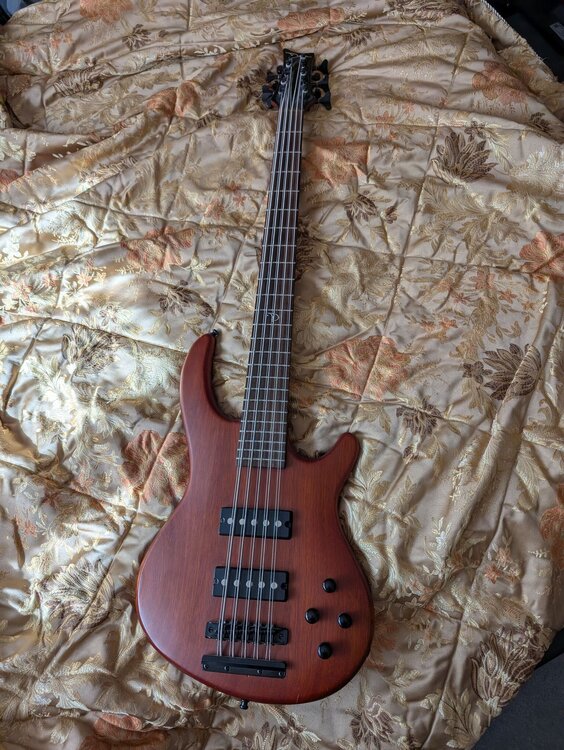 Yes.
Yes. -
When I were a lad, I found those impossible to tune to. I could probably manage it now.
-
I don't understand the logic. If you bought it for the sound, why do you want to change the sound by replacing the pickups?
-
When I started, I'd tune to the piano in the house. In a band, we'd take somebody's guitar as the reference and tune to it (can't remember how the reference was established) or, if we were rehearsing in a rehearsal room at school, tune to the piano. Then electronic tuners came in at consumer prices when I was in my early 20s (the ones with a real meter at first) and I never looked back.
-
Sir Horace Panters “Ghost Town” Precision Auction
tauzero replied to Lozz196's topic in General Discussion
I bought a Shuker Uberhorn fretless last year which turned out to have a duff truss rod - in a way it was a blessing, as I took it to Jon who is almost finished rebuilding it with a new fingerboard and truss rod and a scale length revised from 35" to a tad over 34". Hoping to pick it up next week. OTOH, the Barcus 6-string fretless I got for a pretty good price (IIRC it was below the original starting price) is great. Incidentally, the ludicrous fan-fret Megatar didn't sell last time out and it's back again. If you want a straight 12-string tapper, fine, but all Megatar/Stick tunings that I've found have the six bass-side strings with the lowest string closest to the centre of the fretboard, completely obviating the point of a fan fret. You'd need chevron frets to make sense of it. -
Sir Horace Panters “Ghost Town” Precision Auction
tauzero replied to Lozz196's topic in General Discussion
And bought back, and now is getting rid of again. -
Sir Horace Panters “Ghost Town” Precision Auction
tauzero replied to Lozz196's topic in General Discussion
Don't forget that there's a buyer's premium which with VAT comes to a tad over 25%. And the seller's premium is similar, so the seller actually pockets about 50% of what the buyer pays out. And people moan about Ebay charge. -
Sir Horace Panters “Ghost Town” Precision Auction
tauzero replied to Lozz196's topic in General Discussion
Which one of the dozen or so? I can't help but think of an impressionist (can't remember who) who used to do Jimmy Savile saying "Showaddywaddy". That's a bit offputting. -
Do you mean they're the base version of the full-power band?
-
Isn't using a fretted Jazz instead of a fretless Stingray enough of a difference?
-
I've made one of these. I'm still not sure exactly why, haven't decided on a use for it yet. To decode the keypresses, I'd use a MM74C922 encoder which will generate a 4-bit number depending on which of 16 buttons is pressed so you don't have to try to connect 13 switches to the Pico. Then you need to connect the switches between the X and Y connections like so: X 1 2 3 4 Y 1 C C# D D# 2 E F F# G 3 G# A A# B 4 C Fn1 Fn2 Fn3 That gives you 0 for C, 1 for C#, etc. As far as the challenge goes, it's difficult to say. Strict observation would give a Tier 2 fail on purchase of the MidiMuso kit, as that's where the intent to create a MIDI controller manifests itself in a purchase. Up till then you could have just been building a Mandelbrot display https://www.instructables.com/Mandelbrot-Set-on-Pi-Pico-ILI9341/.
-
And no taking your wife, either, in case she tries to outdo your girlfriend.
-
No, because it is you who committed the act.


