



-
Posts
1,001,526 -
Joined
-
Last visited
-
Days Won
3
8 Followers


Recent Profile Visitors
69,785 profile views


Dood's Achievements



-

If you were starting today, what’s the best way to learn?
Dood replied to Useless Eustace's topic in General Discussion
Yes, yes and yes!! I've been lucky enough to work with a wide range of students for many, many years - those at school, retirees, SEND, those with greater complex and specialised needs and even groups of sufferers of dementia. I slammed like on your post! I'm also a fan of that lil quote by that chap who was quite good with science: “If you can't explain it to a six year old, you don't understand it yourself.” -
If you were starting today, what’s the best way to learn?
Dood replied to Useless Eustace's topic in General Discussion
Absolutely, one size definitely does not fit all - an argument often levelled at mainstream school teaching in general. However, on a 1-2-1 basis, if lessons are 'too restrictive' or 'hold a student back', then that is the teacher at fault. They haven't understood the students needs or are not experienced enough to cater to those needs. That said, personal drive is necessary for progress and if the horse doesn't want to be led to water or accept the water is there to help them.. -
Blue Aran dropped a link to these on my feed the other day. https://www.bluearan.co.uk/index.php?manufacturer=JAM_Systems&masthead=Amplifiers&subheadnew=Stereo_Power_Amps I've no idea if they are any good but I'd be suspicious of any amplifer marketing suggesting 2000W @ 8Ω for just under 600 quid.
-
If you were starting today, what’s the best way to learn?
Dood replied to Useless Eustace's topic in General Discussion
Or knowing when the song you are playing is totally killing the dance floor on that occasion and how to communicate quickly to seamlessly get out of it in to the next song! -
If you were starting today, what’s the best way to learn?
Dood replied to Useless Eustace's topic in General Discussion
A lot of people equate lessons as just being about technique, reading music and theory. Yet all of the elements you mention I teach in lessons. The other day I was teaching recording techniques, another, soldering and electronics, the weekend I'll be setting up a video recording and editing software. My friday student is learning about stage craft ( and many of the points you've mentioned) and today a student is learning a quick way to remember all the notes on the bass neck. Genuinely, hand on heart, I learned the long and hard way. The internet didn't exist, my ear was honed dropping the needle on the vinyl. I had a long (previous) career in IT and have an obsession with audio technology and, I've picked up a stack of stuff on the way that I wish I knew sooner - and given the amount of questions I get about the same things, I figure everyone else does too - so, thats what I teach (as well as what folk would term 'the usual stuff'). Do we need formal lessons though? Not entirely no. I can draw a picture without going to art school, but for those who haven't been to art school, may never know what they are missing out on. - And no, in case it comes up, music theory doesn't ever dillute one's identity on the instrument. That's gatekeeping BS. -
If you were starting today, what’s the best way to learn?
Dood replied to Useless Eustace's topic in General Discussion
Yes to this! I've taken on students from other teachers and there has been, well, lets just say, a certain amount of retraining required. Not just theory and technique, but the way that they have been taught previously. For example, not being able to retain information or identify theory elements. On top of that, "teachers" being unable to identify the student needs and that each of us absorb information in different ways. This week alone I am probably 10 different teachers rather than a one-size-fits-all course trying to fit paying customers. Thing is, for a new student, how will they know this is what they are walking in to? It's difficult. I try to explain my 'ways of working' as best I can and openly invite new students to feel comfortable to choose if they wish to progress with lessons with me. I'm lucky I guess, I have a long waiting list. Oh and to answer the question about lessons and online - yes it can be helpful having more than one person explaining the same information as it can aid retention. I also like it because I ask my stidents to challenge what I teach. It also always opens up new conversations and avenues for lesson content. The comment about finding a teacher that inspires you is really important too I feel. Someone who is excited about their subject. I have kids and my eldest is mature enough to identify which teachers she has are tired, bored, fed up with their jobs or lack the acumen to be effective. I'd hope that if I ever get to that point, I move on to something else that fills me with as much joy as my current career. -
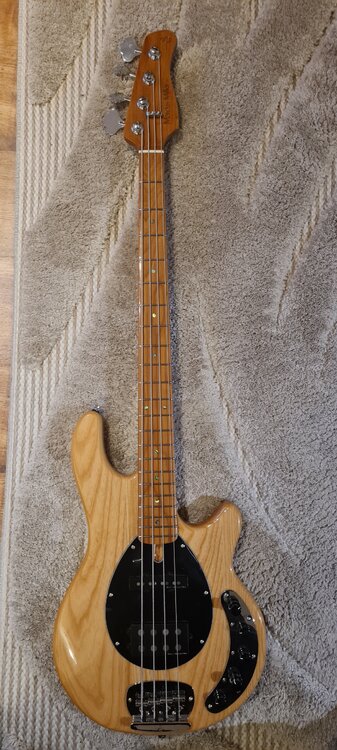 The Z series has a slightly different shaped headstock vs the other Sire models. I actually way prefer this shape. It is subtle yet better in every way.
 -
Here;s my latest review to go live for Bass Gear Magazine! As always, please give my reviews a like and a postive comment in the usual place - I love making these reviews for my fellow bass chatters, I'd love to have your support ☺️ - Goodness knows how many times youve helped me in the past! https://www.bassgearmag.com/ebs-runsten-multi-dc-isolated-pedal-power-supply/
-
I really appreciate that @RichT! Thank you so much! -The Vox Starstream active model was just brilliant! I recall it sounding thunderous in the studio in drop tuning, even now!
-
I fancy a pickup change. Jazz type, passive humcancelling?
Dood replied to fretmeister's topic in Repairs and Technical
Bit late to the party but, the EMG X series offer all of the benefits of any EMG active, but offer the "less hifi"you request vs the non-X series. That said, just using the passive tone control on a set of EMG non-X actives can do the same. Though the X seires do 'feel' a little different due to their additional headroom. -
Awww! Yes! I remember my Powersoft! What an absolutely beast of an amplifer! Highly recommended - though, they do require a deep rack case rather than the shallow versions. I think mine was about 1K a side, which is just bonkers. but fun.
-
Ahh! That's because the price of the screws back in 2016 were £4, but the Upcharge for Purchasing Secondhand many years later, or "UPS" as we like to call it means that the item is now £52. UPS is often seen in marketplaces such as facebook, a tax on tatt and over inflated perception of demand.
-
£26 instead of £99 - https://www.pluginboutique.com/product/1-Instruments/64-Virtual-Instruments/1560-Xpand-2
-
I've also fallen down a bit of a Jean-Michel Jarre rabbit hole again - My dad loved JMJ - so I've been grabbing lots of CMI Fairlight samples and all sorts. Whilst on my journeys, I found Arturia's Lab Play virtual instrument - which is free and sounds really good. There's a JMJ pack for it for anyone who wants to re-live some Equinoxe and Magnetic Fields vibes too. https://www.arturia.com/products/software-instruments/analoglab/free For awesome synth sounds, keep an eye on Plugin Boutique for when the do a deal on Xpand2! which could be my favourite multi-voice VSTi.
-
Woodstock Audio are giving away a Compressor plugin that offers visual feedback of what it is doing to your signal. A useful way to learn about compression as well as having a graphical representation over and above a set of level indications. No account or serial needed. https://woodstockaudio.com/products/waveform-compressor


