


Osiris
-
Posts
2,066 -
Joined
-
Last visited
-
Days Won
4
Content Type
Profiles
Forums
Events
Shop
Articles
Everything posted by Osiris
-

 @Jack Higgs no problem, drop me a private message and we'll go from there.
 -
The Short Scale Bass Appreciation Society!
Osiris replied to Baloney Balderdash's topic in Bass Guitars
To concur with EZbabes, I don't think it's worth the time and effort. My 2 main gigging basses are a JMJ Mustang and a Sandberg Lionel with an EMG Geezer Butler pickup, one of most highly regarded Precision pickups. In terms of tone, the JMJ is way more P like, as in pretty much identical to a P albeit with a bit more of that short scale fat low end. The Sandberg is way more polite in comparison, and for tastes, doesn't come close to the classic P sound as the pickup position is around 10-15mm closer to the bridge compared to the JMJ. -
Line 6 rack mount kit for G55 & XD-V55 wireless systems. Used but excellent condition, comes with options to rack mount either one or two systems in a single rack space, antenna cables (but not antenna - you add on the ones from your receiver unit - rack screws, fittings with hex key. All boxed with instruction manual. No idea what this is worth so asking a tenner collected from the Wellingborough area or I'm happy to post at cost, probably around £5.
-
What are your irrational prejudices? I have some bonkers ones...
Osiris replied to kwmlondon's topic in General Discussion
Being a soft southern Jessie, it's not a phrase I've come across before, would you care to elaborate? Bearing in mind that this is a family show, of course. -
What are your irrational prejudices? I have some bonkers ones...
Osiris replied to kwmlondon's topic in General Discussion
Following on with the theme of appalling Americanisms defiling the Queens English, I mentioned this way back on this thread and it warrants repeating... Tubes (pronounced toobz) when used by folk from this green and unpleasant land referring to valves. Yes, I know it's what those shouty, excitable cool kids from out in the colonies call them on YouToob. But you're not from Minnesota are you, you're from Halifax. So please stop it or I'll be obliged to give you a damn good fisting. -
What are your irrational prejudices? I have some bonkers ones...
Osiris replied to kwmlondon's topic in General Discussion
You Sir, are clearly a man of impeccable taste. Will you marry me? -
Agreed, why on earth are people still making sunturdburst instruments in this day and age??? 😮😢😭🤢🤮
-
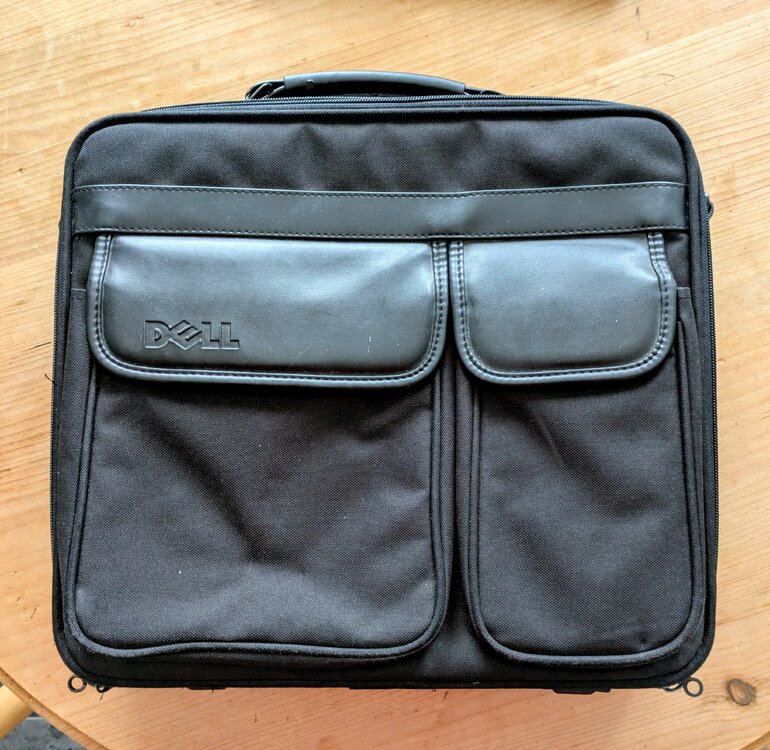 Nothing to see here, move along.
 -
Despite the click bait title, the more observant amongst you may noticed that this bears a striking resemblance to an old school Dell laptop bag. And while I can neither confirm nor deny any such speculation, what I can confirm is that this is the perfect protective bag for a class D amp. It features rivetted in (leather?) handle, a rigid side frame, plenty of padding and loads of pockets inside and out for cables, a pager and your Filofax. It offers way more protection for your amp than the overpriced branded gig bags that manufacturers offer and at a fraction of the price. The internal dimensions are 33 x 28 x 6.5cm although there's a bit of flexibility to expand slightly due to the padding and a slight give in the (presumably plastic) side frame. I'm asking a whopping tenner for the case collected from the Wellingborough area and am happy to post at the buyers cost, I'd guess around a fiver.
-
Update, I took the combo over to a mates house this afternoon, the always lovely @Tmg, with the intention of swapping out the preamp valves, and the amp was not making any strange noises at his place, nor his place of work around the corner, which he assures me has dodgy electrical wiring. We even set it up right next to an old tower PC running 3 monitors and could not get any unhealthy noises out of it. And once back home it was still behaving itself. So, with the lack of interest when I had it up for sale last year for months, plus a possible intermittent issue (although the only place this has happened was at Ainsleys' place as discussed in the original post) I think I might as well hang onto it as it really does sound glorious especially when cranked up. In the words of my late granddad, Well, bugger me, boy.
-
Thanks, that's very helpful. I'll probably go with a set from here as they claims ot be a matched pair for the specific model - https://www.ampvalves.co.uk/product-category/choose-your-amp/ashdown-amplifiers/ashdown-220-touring/ But I'm going to contact Ashdown first and see what they have to say and will likely book it on for a service as it's probably long overdue.
-
Thanks guys, I've never changed the valves, from what I understand the preamp in this range was not designed to break up into saturation or to be overdriven, so I'd never seen much point to changing them especially as I like it how it sounds as if is. But I'd been talking to a mate about it who also suggested the valves being the potential problem, and with these suggestions it sounds like a good place to start. Do you guys have any recommendations for the brands to go for as I don't really know much about them having not owned a valve amp since the 80's.
-
The amp makes the noise even without a bass or cable plugged into the preamp. It also does it when muted too. So I don't think the problem is with the bass, but for the record I have 3 basses, all passive and all well shielded and no more noisy in use with other amps than any other basses I've played over the years.
-
Funnily enough, we discussed this at the time we were investigating the noise at Ainsleys' house. I'd always set the gain level and controlled the output with the master volume, always have as at some point in the depths of time I'd been led to believe it gives you the best signal to noise ratio. But I've heard of others doing the opposite. And it's what originally highlighted this issue.
-
But I'd expect any extraneous noise to be muted when the amp is muted, like the way amp hiss is. That's not happening here, the noise is present even when the amp is muted. That doesn't seem normal to me which makes me suspect there's more to it that being one of those things. Was that your experience with noisy gear too? It's a first for me having tried dozens of different amps over the years.
-
For how I use it it's absolutely fine, even with the PC on as it never really needs to be above around 10.00 on the master volume for plenty loud enough at home levels. It's just that I could do with moving it on just to clear some space in the room it's in and based on your experience - and it was very noisy with the master up and the gain set low when we tried it at your house - I want to be certain that any potential buyer doesn't have the same issues.
-
What are you saying here? It's just a part of the inherent design of the amp? Something else?
-
I use decent cables, Sommer, Van Damme and Neutrik. I do usually use a small pedal board with it, compressor, tuner and HPF, but funnily enough the amp tends to be quieter with the board inline than without it - and the pedals are daisy chained too which the internet tells me is guaranteed to introduce noise, yet it definitely help alleviate any noise even with the PC on.
-
But why is this amp susceptible to noise when I've used several others in the same location that have been noise free even when the PC has been on?
-
I have an Ashdown Touring 220 combo, it's a twin valve pre-amp into a solid state power amp. Last year I put it up for sale and agreed a trade with @AinsleyWalker but he reported it having a lot of inherent noise when the master volume was cranked beyond around 12 o'clock. I went to his house and indeed it was very noisy even when on standby, not just the hiss you get when turning an amp up loud but what I would describe as more of an electrical interference, buzzing type of noise. So I took the amp back and at my house it's pretty much silent unless I have the PC on which I often do when learning new music. With the PC off, the amp is no more noisy than any other I've used over the past 40 years ago. This makes me think it's possibly picking up some sort of electrical interference. So my question is what's causing this? The amp is probably 10-15 years old and never been abused. But it's never been serviced either. Ashdown have an excellent reputation for fixing their amps but at a 200 mile round trip, plus the time required to take it to them (it could possibly be posted by weighs around 6 million tons) I'm wondering if it's something that could easily be fixed by an amp tech closer to home? Plus, it doesn't seem to be worth that much so I'm reluctant to spend a fortune getting it fixed if the 'repair' is disproportionately high to its value as I'll probably still move it on at some point. Any thoughts as to the possible cause and approximate cost of getting it sorted?
-
The Short Scale Bass Appreciation Society!
Osiris replied to Baloney Balderdash's topic in Bass Guitars
Yes, I probably should have mentioned the weight, it's around the same as my JMJ and noticeably heavier than the Sandberg but I do find it easily manageable with a wide strap. -
The Short Scale Bass Appreciation Society!
Osiris replied to Baloney Balderdash's topic in Bass Guitars
I've got one of the Harley Benton Mustangs and other than shielding it and upgrading the cheap pots it's stock and holds its own on a gig alongside my JMJ and Sandberg shorty. In fact, of the 3 it's my favourite sounding bass although the other two are no lightweights in tone - my 'Berg is fitted with an EMG Geezer Butler but the HB still holds its own. Mine is from the first run with the Gotoh machine heads. It has a slim, jazz profile neck too which might work better for you daughter than the slightly chunkier classic vibe neck - although I'm going from memory but there might be that much in the necks in a direct side by side... -
Oddly enough, letting the lows through either uncompressed or with less compression than the highs and mids can help the lows sounding bigger and deeper, try playing with the HPF on one of the Origin Cali units to hear it in action. IME, keeping the mids and highs in check is usually more beneficial, although I do use a single band comp as for my tastes, what it does to the whole signal is more important to me on a gig than a more studio like quality to the low end. But it's down to personal preference. From what you're describing you might possibly get on with the Boss LMB-3, which I mentioned above as being my go to. It keeps the lows tight, add a massive mid range punch but can roll off the highs a bit. You can use the Enhance control to add some high end back in but it honestly sounds a bit cack, like a cheap 80's active preamp. I fund cranking the treble in the amp to taste a better solution.
-
I can't remember if the editor is or was a separate app to the one you download tone prints from, it's been a few years since I had a Spectracomp but I remember editing it hooked up to my PC so it might be you can't (or never used to be able?) to do it from a mobile. As for the single knob (fnarr) you can program it in the editor to simultaneously control up to three of the fifty or more parameters, and you can control the range of those parameters too. Most of the tone prints seem to use it to affect ratio, threshold and/or volume but they can be configured to control any editable parameter so if you wanted to lower one of the crossover frequencies while upping the threshold of the mids and reducing the attack speed on the low end you can. I also had a Hypergravity at one point, effectively a four knob spectracomp, with that I'd dialled it in to work as an adjustable pseudo high pass filter on the lows, a wide frequency single band over everything from the upper bass to the high mids, and a tapered high end roll off, each on individual controls and I think the other was a master volume. It wasn't perfect but it shows what you can do with it given the time and inclination.


