



SumOne
-
Posts
2,370 -
Joined
-
Last visited
Content Type
Profiles
Forums
Events
Shop
Articles
Everything posted by SumOne
-
At least Bass playing is potentially quite a sociable thing (or even if only playing alone at home - it gives the skills to play in a band at some point). And it is relatively cheap. Most other instruments cost more. A second hand Bass doesn't really depreciate if well looked after. It's basically a refundable deposit. And I think playing music is good mentally. It feels to me like it uses different parts of the brain to my day job. Good for sort of zoning out and I suppose a sort of meditation. I saw the other day that model trains can be £400 just for the engine bit and about £40 a carriage, a decent model railway must cost people many thousands. Many mountain bikes are £3k and expensive to maintain and depreciate quickly. Then look at the cost of hobbies like Golf, vintage cars etc. Bass is positively budget in comparison.
-
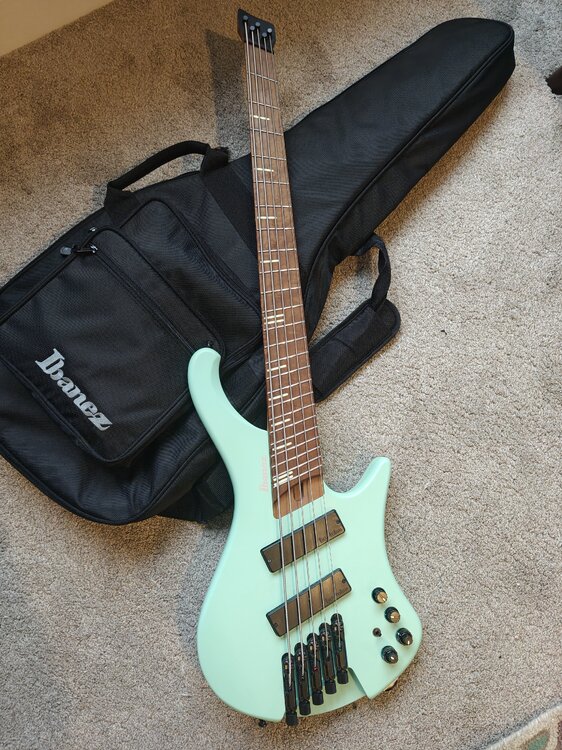 The 4 string I was after has been sold. Trade considered if anyone happens to have a Japanese Fender Jazz 4 string.
 -
The Boss RE-202 space echo is great....it is quite pricey but the RE-2 is cheaper (or the older RE-20 is starting to get cheaper second hand). .....but I didn't actually find much use for it (and the reverb it has) with Bass, e.g. dub reggae is full of delays on just about every part of the music - apart from the Bass that stays as a solid foundation. So I do have my eye on getting one again, but to use with keys rather than for Bass. Perhaps there are certain delays (or genres) that are better for Bass delays though?
-
 I think it is a bit unfortunate that Boss have virtual pedals available but instead of charging something reasonable like £10 each as a one-off payment they are charging $49 for 3 months subscription and that is the only option. Apple are charging £5 per month for iOS Logic subscription and subscription is the only option. If virtual pedals are the future then it looks like the big companies will want you to pay monthly...they don't want you getting stuff you could sell second hand, which I do always think is a big benefit of hardware - buying a pedalboard of second hand Boss pedals might cost >£500 initially but then you could probably sell them all 5 years later for a similar price, it's basically a refundable deposit if you look after them. Whereas that $49 every 3 months for 5 years = $980 and once you stop paying you have nothing to sell.
 -
I'm probably late to the party on this, but iPad with GarageBand and an audio interface seems to work well for live monitoring and adding some basic effects, key thing being latency is not noticable and it all seems stabel/reliable. It can also do some stuff even quite high-end multi-fx don't tend to do like live EQ visual analysis. Stock effects aren't great but I guess third party ones can be decent, and it has tuner/mute. I've not used iOS for live Bass guitar effects stuff so any recommendations for apps/plugins would be good, low latency being essential. I see Logic on iOS is a subscription only thing now, £5 a month, I'll give the free trial a go. I think this could be quite a portable and useful setup to take to rehearsals: Some basic 'always on' effects and tuner, and the option for metronome and drum loops, recording, playback. etc. And it is an easy setup to just then also use at home for practice and recording, and then with just the iPad on my train commute to arrange tracks etc. This stuff has almost got to the point of replacing multi fx for me, especially as reliability and latency issues seem to be solved, both were real issues just a couple of years ago, it is something Apple things seem to win on. My relatively new and powerful gaming Windows Laptop seems to have a new update to something every time I turn it on, and latency still seems to have a mind of it's own via Reaper - the same saved file will be fine one day but the next time seemingly without changing anything it becomes noticable (presumably a VST, or Windows, or Reaper, or any number of other things has had an update in the meantime and changed to some defaut buffered setting or something - it becoems a headache to figure out what, not something you'd want to do at the start of a gig), the more clossed system of iOS I think helps with stability for stuff like that. For live stuff, the iPad and interface thing would needs a bit of 'gig-proofing' by securing down (perhaps velcro on the iPad and the interface), turning off wifi/updates etc before a gig, and it needs footswitches - I like the idea of wireless options like the Ampero , and the Boss FS-1-WL also looks good as that can be battery powered.
-
I'm eating my previous words as the SP 404 MK2 is currently on its way back to Amazon for a refund. It's not that it's a bad bit of kit, just that at £420 it is hard to justify when things like an iPad (or even a phone) are so good for a lot of this stuff nowadays. The 404 feels a bit like a throwback to hardware from 30 years ago. My iPad with Gagageband (free), Patterns 3 drum machine (£20), Koala sampler (£5), Synth One J6 (free), together have so many more features even just for sampling - like stems separation and ease of visualising and chopping samples, and are much better for stuff like visualising and moving about drum patterns or full song structures or using for virtual instruments, file management etc. and it's more portable. It's quite telling that a £5 app like Koala is included as a sort of partner product with the 404 as it basically mirrors almost all of the features via an app but then has additional things like stems separation and instant access to however big your phone/iPad storage of samples is (instead of the 16GB workably accessible on the 404 which you end up moving from your iPad or Laptop anyway if you want to do stuff like stems separation and file management). The obvious caveats are if you need to buy a Laptop or iPad and audio interface specifically for this then that is at least the same cost as a 404. And there are hardware limitations to iPad/Laptop/Phone for live stuff - at a minimum something like a small Akai midi interface would be useful for finger drumming. Costs can add up and once you start adding things complexity there are risks, set up at gig and unexpected 'computer says no'. As far as using stuff like the 404 as a Bass multi-fx though, I think I need to conclude that the best tool for Bass multi-fx are Bass multi-fx pedals! Even something as cheap as a Zoom B1-4 is much better suited to that job than things like a MPC or 404. ........Although saying that, I am now a bit 'iPad curious' as a live effects unit. I have it set up with my usb audio interface at home and am hearing no noticeable latency and no audio issues. Is this perhaps a new rabbit hole of trying to use this iPad setup as my Bass multi-fx?!? I think it could work well for 'always on' type effects with it sat on my amp at rehearsals but the faff and cost of making it 'gig proof' and adding midi footswitches for live use probably makes it a no-go.
-
I think the Japanese concept of 'Kodawari: The relentless pursuit of a perfectng a craft' right down to very small details, kind of fits doing piano grades...or certainly more so than my somewhat punk attitude to playing Bass! My lessons mostly consist of the teacher telling me to slow down, focus on one small section, perfect the details, repeat, and repeat again! He has suggested I could possibly pass Grade 3 in June, or at a bit less of a rush to do it in November, so that keeps me on track of my longish term aim is to pass grade 5 before I turn 50 in summer 2029. So I'd better embrace the process for a lot of hours yet and get all 'Kodawari' on it!
-
£339 at Gear4music, available in April. Edit- just realised this is old news, posted a few posts ago.
-
I got a Roland SP-404 MK2. It's a great bit of kit, you really get a lot more for your money with these things that sell to a wider audience than Guitar/Bass players. Economies of scale I guess. For live multi-fx type stuff it has instrument level input, and 'input fx' setting that includes guitar amp Sims (unfortunately no Bass specific amps) and stuff like the 'warm saturator' that I like for a bit of drive and EQ (even though the name 'warm saturator' seems to imply wetting yourself.... perhaps that says more about me though!), you then have the buttons by the screen for a single fx on/off 'filter and drive' etc (the effects can be re-assigned), and then 3x additional fx that can be put in series or parallel but are trickier to access so are good for always on stuff like compressor. It also has some interesting fx you don't usually find on multi fx, e.g. Vinyl and Cassette sim. It is not ideal as a traditional multi fx replacement (not stompable, no tuner/mute, input fx settings aren't changed via patch changes), but it could make do - especially for 'always on' type things or for home use. What it wins on are some of the quite unique fx and stuff I haven't got into yet like quickly looping stuff you've just played and re-sampling with new fx. .....but of course live multi fx isn't its main use. Mostly it is a decent portable sampler/trigger, sequencer/production tool, stereo interface (instrument/mic in and stereo line in/out and usb, midi in/out) and can even be used as a DJ controller. Battery powered too - it should keep me entertained on my train commute. I could see myself using this placed up by my amp to have on for 'always on' bass fx and occasional fx on/off via the buttons, but that's only probably worthwhile if I also use it to trigger samples and loops - otherwise a cheap stompable multi fx would be more appropriate. I'll also be using it for samples/loops and adding live fx for when I play keyboard (and can potentially play samples chromatically via midi keyboard but I'm yet to do that), and as an interface for home recording (a very useful 40 second memory is always on - so you noodle something you like you can go back to it and sample/save it), so for me I think it is well worth having.
-
I'm sure as we are all analogue playing musicians on this forum that most people will see that Suno CEO as the enemy. But I think he might have a point on one thing: Technology will be able to really 'gamify' music and open up brand new stuff - e.g. you're at a birthday party and all say a few prompts 'make a rock version of Happy Birthday for John, make fun of his hair, add a Kazoo solo' and a visual app to 'suggest dance moves' then 'record us performing this song/dance in the style of a 80s hair-metal stadium performance', upload and share with 'John's birthday party TikTok group' etc etc. The end product will be throwaway and pretty much worthless to the rest of the world (there are already 100k songs uploaded to Spotify daily, so we're nearly there already), the value is in the experience of those that 'created' it. But even that scenario is a bit depressing, a party could alternatively just sing a song, do a kazoo solo, dress up and do a dance all without any use of technology....but I guess times are a-changing and people like using technology for this sort of stuff. I suppose it could make your party more global and not face to face, which again I'd see as a bit of a shame in many ways. Perhaps there's room for that, and still room for semi-retired blokes playing a P Bass in the pub to do their cover of Mustang Sally for the 100th time to an indifferent audience and feel accomplishment/joy in the experience of performing and artistic expression? Either way, they don't necessarily need to have much artistic merit for people to have fun with it.
-
In a way, I'm all for people running riot with it (not that I think Al is). These online only stores have put traditional stores out of business, accepting returns is part of their cost of doing business. I went to the Roland (Boss) store at Denmark Street and they would not price match their online Roland store Amazon price. I was there in the shop ready to buy but it saved me £15 to get it via Roland on Amazon - next day delivery and 30 days free returns that the shop doesn't offer. It made no sense to not buy it from Amazon (unless I really needed it there and then instead of next day). I feel of the government doesn't act then all sorts of shops will close. One partial way of balancing things is to not feel guilty about using your legal right for online purchase returns. (I think the business model of that Roland store is to be a big Roland advert though, not necessarily to be profitable as a stand-alone shop)
-
Native Instruments in preliminary insolvency ...
SumOne replied to rwillett's topic in General Discussion
Perhaps a bit different from what you're saying, but two of the eight Grammy nominees for 'best new artist' first got fame via TikTok (Addison Raye, Alex Warren). And the winner of best music video was Deochii (who got fame as a Youtuber vlogger). So I suppose at least for them social media got them audience and then they monetise it by becoming musicians and selling gig tickets and merchandise and endorsements etc. -
I think it's just a different flavour of that, or it can be. People said similar with sampling, synths (memories of my Dad's distain at 80's '1 finger keyboard players'), drum machines, DJs, Laptop music etc. Granted, they did all need people to a certain extent (but lazy people could just use drum machine presets and a synth arp preset), but it depends how people use AI to how much input they have - could be anything from just mastering a track all the way up to making it all via a prompt (and isn't that a bit like the non-musician producers that just tell musicians how to play?).
-
I assume some of the backlash against Punk was similar. And probably Rock n Roll before that, and Blues before that. Music isn't all about technical skills, it's about expression - if AI can help people express themselves then is it always a bad thing? I suppose there is a spectrum regarding artistic input. People that studied music for years and struggled to make a living in an orchestra probably looked at punk musicians with the sort of distain people look at people using AI for helping write music now. I suppose a key thing with Punk was the democratisation of expressing yourself through music - whether or not you were lucky enough to have been able to go to a music conservatory or have the time and money to practice. AI supporting artists possibly does similar. Nearly 50 years after punk and we still have music conservatories and orchestras of highly trained musicians and people that appreciate hearing that, and a lot of musicians (e.g. rappers, DJs, pop singers) that could barely tell you the difference between a major and minor chord. There is room for both.
-
I wouldn't be at all surprised if Gazz wasn't a real person, just an AI bot prodding about to see what word combinations get interaction.....or perhaps is a real person doing similar.
-
That's interesting as my synth bass pedal conclusion usually is: Honeymoon period = 'most fun effect pedal ever, hours of tweaking, this'll sound amazing live'. Then after a few weeks 'the sounds are actually a bit cheesy, I spend too long tweaking it instead of playing, not sure I can trust it live and it feels a bit disconnected/tracking can be an issue' After a couple of months 'Sell it as I'm better off with envelope filters, octavers, overdrive, modulation etc. that feel immediate and reliable and like Bass guitar effects instead of a cheesy outdated synth'. I think this MXR and the latest Future Impact version might change my thinking though.
-
Ah right, I stand corrected. I thought that Direct Drive wasn't ideal for hi-fi and the 1200 types were all DJ focussed. Either way, years of DJing and playing in bands means my hearing wouldn't tell any difference between hi-fi and fisher price!
-
I'm a big fan of Technics. Have had 1210's for 30 years with only small bits of DIY maintenance needed. So getting the 1200GR2 I'm sure would be the last deck you'd ever need to buy. .....however, I'm not certain the 1200GR2 (or older versions like 1200 and 1210's) are ideal for home listening. Isn't their main design for them to be built like reliable tanks to withstand DJs doing stuff like this: It's like getting a tank to do the school run. A lot of unnecessary cost, bulk and toughness, while missing some features that would be nice to have.
-
I think in terms of processing power, build quality, sounds, and price it's still very competitive. I'm not sure anyone really needs more than 3x parallel paths and 24 simultaneous effect blocks. And the sounds all seem good to me. What would be interesting (but not essential) are some more innovative sounds: Synth, Arpeggiator, sample triggering, tone capture, glitchy stuff etc. And I think all multi fx need to put more effort into the user interface, it's the main reason so many people still use individual effects pedals. e.g. if a live situation I'm using a multi fx for Compressor, Amp sim, Drive, and just one part of a song I suddenly feel (with no preset pre planning) a phaser would be good - how realistic is it to be able to do Vs individual pedals where it's just 'stomp on the phase 90'.
-
Yeah, I don't think Bootsy does anything as mundane as getting out of bed and getting dressed in the mornings.
-
The Core would be the more sensible option, not leasst as I'm always considering how useful pedals can also be with my keyboard (Core for stereo effects etc will be useful for both Keys and Bass). ...but I'm not a particularly sensible person!
-
I've been eyeing it up too (helps that it has just been payday!). Did you order it from Music Store or direct? I basically have no pedalboard at them moment (well, just a tuner), so if wearing my sensible hat I should probably get a couple of things like compressor and overdrive before the next gig....my amp can do each of those things and it can't make FI type noises (unless something is giong quite wrong!) so I think I might take off my sensible hat and put on this one to get a FI v4
-
That's very true for those that want to have pride in their artistic efforts. Unfortunately though, the goal for many isn't artistic integrity and having pride in what they've created - it's reaching the goal of making £ and presumably getting AI to fully compose music might be a way of achieving that. Perhaps this isn't true, but people are suggesting that companies like Spotify and Amazon music are using AI to create music and are promoting it on their playlists as they then don't need to pay royalties. e.g. Ask Alexa to 'play relaxing background music' and it is in their interest to play bland innofensive AI generated stuff they don't need to pay for.
-
Sounds like a good update, I might give a v4 another go. I had a v3 and liked it, but didn't like the octave tracking jump thing (I play a lot of octaves with synth bass), so I sold it to get a C4. A few years later I got a FI V4 but had hours of hassles trying to get it to connect to my Laptop but no luck, could've been my Laptop and the many competing drivers and midi things on it, the midi connector, or the FI, not sure - but my patience wore out so I gave up in the end and sold it (I do think this is a bit of an overlooked thing and hence a lot of the popularity of the MXR, people just want something that works easily, no faff). However, if I can do program order editing and a decent level of parameter editing directly on the pedal then I'm not too fussed about Laptop connection (just as long as I can also switch the slow/fast tracking via the pedal). Bonus for me is my Keyboard doesn't have a proper synth (just samples) so I'm keen on getting a small midi triggered synth unit (had been looking at things like the Behringer JT Mini). Is the FI v4 always monophonic - or can it do polyphonic when controlled via midi?
-
Fun fact: The Royal Society* motto since 1662 has been 'Nullius in verba'....meaning 'take nobody's word for it'. So I suppose not much really changes. *the world's oldest national scientific academy.


